UK licence check – 26 September 2026
FatPirate UK Licence Check: UKGC Register and GAMSTOP Context
 Available in GB
No UK Gambling Commission licence for FatPirate or fatpirate.com was verified in the current public-register check. That finding matters because the Gambling Commission states that businesses providing remote gambling to consumers in Great Britain need a Commission licence, including operators based overseas. It does not, by itself, answer every other question about whether the site can be reached, whether an account can be opened, or what happened in an individual customer dispute.
The practical distinction is simple: access evidence and licence evidence are different evidence categories. FatPirate’s current Terms do not list the United Kingdom among excluded jurisdictions, but that is not a substitute for a UKGC register entry. Likewise, the lack of a verified register hit should not be stretched into a claim about a specific foreign licence or legal entity when the available source record on those points is conflicting.
Register method
Table of Contents
- How the FatPirate UKGC check was carried out
- Why a UKGC licence is the relevant local benchmark
- A site can be reachable without proving UK regulatory coverage
- What GAMSTOP coverage does – and does not – establish here
- Why this page does not pick an offshore licence from secondary sources
- Four questions to keep separate before using a remote casino
- What the UKGC register result means for a FatPirate user
How the FatPirate UKGC check was carried out
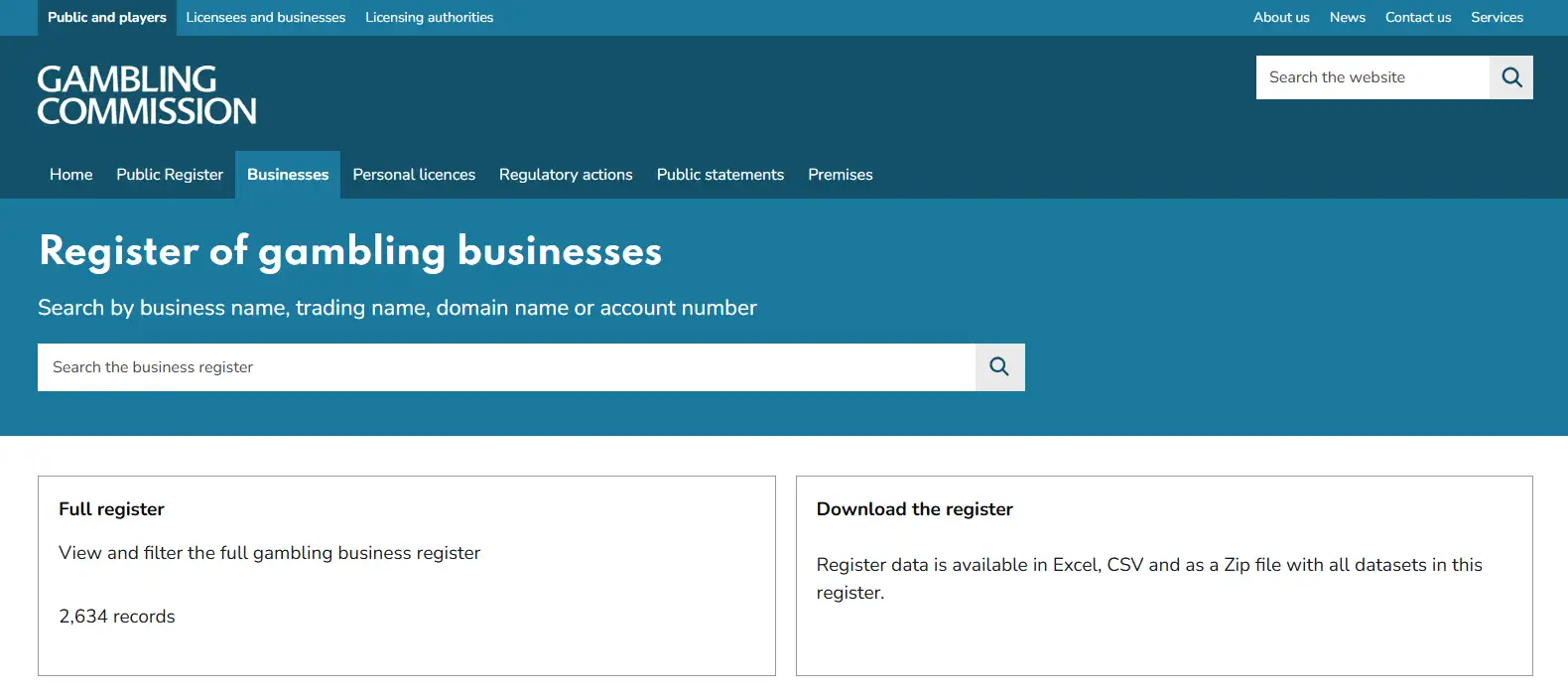
The Gambling Commission publishes a public business register and downloadable datasets covering licensed businesses, trading names, domains and licence records. The current download page was available during this check, and searches were made for the brand name FatPirate and the domain fatpirate.com. No matching UKGC licence entry was verified for either identifier.
This is the right way to test a local-licence claim because a regulator register is the primary source for the regulator’s own licensing records. A review site may describe a casino as licensed or unlicensed, but that description is secondary evidence. For a claim as specific as “licensed by the UK Gambling Commission”, the regulator’s own register is the controlling check.
| Check | Result | What it supports |
|---|---|---|
| FatPirate brand name | No verified matching UKGC entry | No public UKGC licence claim should be made for the brand |
| fatpirate.com domain | No verified matching UKGC entry | The domain was not verified as attached to a UKGC licensee |
| Foreign licence/operator descriptions | Conflicting in the sources reviewed | No specific offshore authority, licence number or operator entity is published here as verified |
The register is a living database, so this is a dated finding rather than a permanent statement. A future licence entry would change the answer and should be checked directly in the UK Gambling Commission public register.
To repeat the check, search the public register by the brand name first, then by the website domain and any clearly documented trading name. A valid match should connect the relevant business or trading name to an active licence record rather than merely returning a similarly named company. Saving the check date is useful because register data can change over time.
Great Britain rule
Why a UKGC licence is the relevant local benchmark
The Gambling Commission’s remote-sector guidance says that a business needs a Commission licence if it provides remote gambling facilities to consumers in Great Britain. The rule is not limited to companies headquartered in Britain. The Commission explicitly explains that an overseas business serving British consumers remotely still needs the appropriate licence.
For casino activity, the Commission separately describes a remote casino operating licence as the licence that allows an operator to offer casino games to customers through a website, mobile phone or other online service. This is why the public register is more informative for a British reader than a generic statement that a casino may hold a licence somewhere else.
That distinction also prevents two opposite errors. The first is assuming that a visible website must be UK-licensed. The second is assuming that a no-hit register check proves the website is technically inaccessible to every British user. Licensing status and technical access are different questions, and the evidence should remain separated.
Primary-source check
The Commission’s current remote-sector guidance states that a licence is needed to provide remote gambling facilities to consumers in Great Britain.
Read the UKGC remote-sector guidance
Access versus regulation
A site can be reachable without proving UK regulatory coverage
FatPirate’s General Terms and Conditions v1.13, last updated 20 August 2026, list a set of excluded jurisdictions. The United Kingdom is not named in that visible list. That is useful evidence about the operator’s published account-access rules, but it does not say that FatPirate holds a UKGC licence.
This is an important information-quality point. A country’s absence from an operator’s exclusion list can support the narrow statement that the operator has not published a general exclusion for that country in that document. It cannot create a regulator licence that is absent from the regulator’s register. Conversely, the no-hit licence finding does not establish the outcome of every registration attempt or every transaction.
The broader FatPirate safe keeps the same separation between official Terms, regulator evidence and customer feedback. Readers who want the commercial overview rather than only the licence question can also return to the FatPirate casino review.
GAMSTOP
What GAMSTOP coverage does – and does not – establish here
GAMSTOP is the national multi-operator online self-exclusion scheme tied to gambling businesses licensed in Great Britain. The Gambling Commission has made participation a licence requirement for the relevant online operators, and its guidance describes GAMSTOP as a way for a person to self-exclude across participating GB-licensed online gambling businesses with one request.
Because no FatPirate UKGC licence was verified in the register check used for this page, this guide does not claim that FatPirate is covered by GAMSTOP. Doing so would require a verified GB licence relationship, not an inference from the site’s own account-closure or self-exclusion wording.
FatPirate’s own Terms contain a separate self-exclusion route through customer support. That operator-level process and GAMSTOP are not interchangeable. A player relying on GAMSTOP should understand that the Commission describes it in the context of GB-licensed operators, while an individual casino’s own account-closure mechanism is specific to that operator.
| Mechanism | Evidence basis | Meaning for this page |
|---|---|---|
| UKGC operating licence | Gambling Commission public register | No FatPirate/fatpirate.com hit was verified |
| GAMSTOP | UKGC licence conditions and self-exclusion guidance | Coverage is associated with relevant GB-licensed operators; no FatPirate coverage claim is made |
| FatPirate self-exclusion | FatPirate Terms | A separate operator-level route is described through support |
Conflicting licence labels
Why this page does not pick an offshore licence from secondary sources
The sources reviewed contain inconsistent descriptions of FatPirate’s foreign licensing and operator identity. Some third-party pages use different jurisdiction or operator labels, while the current FatPirate Terms use the generic word “Company” without naming a legal entity in the visible clauses reviewed. Because those claims conflict, this page does not choose one and present it as settled.
That restraint is especially important for licence numbers, expiry dates and regulator identities. Those details are easy to repeat from copied reviews but materially harder to verify. A specific foreign licence claim should be tied to a current regulator record or another primary source that identifies the brand or domain unambiguously.
The result is deliberately narrower: the UKGC position is based on the UK regulator’s public register, and the unresolved offshore descriptions stay unresolved. This avoids replacing one uncertainty with a confident but unsupported label.
Practical reading
Four questions to keep separate before using a remote casino
- Can the site technically be reached? This is an access question, not proof of regulatory permission.
- Does the operator’s own Terms exclude the country? This shows the operator’s published restriction language, not the regulator’s licensing decision.
- Is the brand, legal operator or domain present in the local regulator’s register? This is the primary local-licence check.
- Do customer reports show recurring operational issues? This can inform risk awareness but does not replace the licence check or adjudicate individual cases.
For FatPirate, those layers do not collapse into a single answer. The Terms and the register answer different questions, while the FatPirate reviews adds a third layer about reported customer experience. If withdrawal mechanics are the immediate concern, the FatPirate withdrawals covers the published limits, internal processing wording and the difference between request handling and money arrival.
Decision point
What the UKGC register result means for a FatPirate user
The specific verified finding is that no UK Gambling Commission licence for FatPirate or fatpirate.com was found in the register check used for this page. At the same time, the operator’s current Terms do not name the UK in the general excluded-jurisdiction list. Those facts should remain separate rather than being forced into a blanket legal verdict.
For a British reader, the UKGC register is the relevant primary source for local licensing, and the Commission says remote operators serving Great Britain require its licence. GAMSTOP coverage should therefore not be assumed for FatPirate without a verified GB licence entry. Any future change in register status should be checked directly before relying on this page’s dated result.
A licence check is most useful when it is repeatable: search the regulator by brand, domain and any clearly documented trading name, then record the date of the result.
Created by the ”Fatpirate Casino” editorial team.